Cost to Sell a Home in King County & Eastside (2026): Fee, Tax, and Hidden Cost You’ll Actually Pay
Nic Chambers April 20, 2026
Nic Chambers April 20, 2026
Most Eastside sellers think they know what they’ll walk away with.
But here’s what I see all the time… They overestimate their net by $20,000–$60,000. Not because they did anything wrong. They just didn’t see all the costs stacked together.
Because the costs aren’t just one thing. They’re layered. Some obvious. Some negotiable. Some… honestly, a bit sneaky if you’ve never sold here before. So instead of guessing, let’s walk through it like we would if we were sitting together looking at your net sheet.
Real numbers. Real Eastside context. By the end, you’ll know what you’re actually walking away with — not what you hope it might be.
Most sellers don’t lose money on one big mistake. It’s usually a series of small, overlooked costs that quietly stack up.
You see a strong sale price and think, “This is going to be a great outcome”. And it can be. But only if you understand what gets deducted before that number becomes yours.
Here’s what I mean: every fee, tax, and decision point below directly affects your final net. Some are predictable. Some depend on strategy. And a few… only show up if you didn’t plan ahead. So let’s walk through it the way it actually happens, starting with the cost that shapes everything else.
Cost Type | Typical Range |
Commission | 4.5% – 6% |
REET Tax | ~1.6% – 3.5% |
Closing Costs | 0.5% – 1% |
Other Costs | 0.5% – 1% |
Total Estimated Cost | 8% – 11% |
Let’s start with the biggest line item. Commission. This is something I see often with sellers…they focus on the percentage, but not the strategy behind it.
Most Eastside sellers still land between 4.5% and 6% total, split between listing and buyer’s agents. Now, you’ve probably heard about the 2024 NAR settlement. And yes, technically, sellers aren’t required to offer buyer-agent compensation through the MLS anymore.
But here’s what’s actually happening on the ground… Buyers still expect representation. And agents still guide those buyers toward homes where compensation is clear. So most sellers? They’re still offering around 2–2.5% to the buyer’s agent.
Not because they have to. Because it affects demand. On a $1.1M home: 5% commission = $55,000
Big number. No way around it. But here’s the real question…Does the strategy behind that commission increase your sale price enough to justify it? Because a $50K difference in sale price is very real on the Eastside.
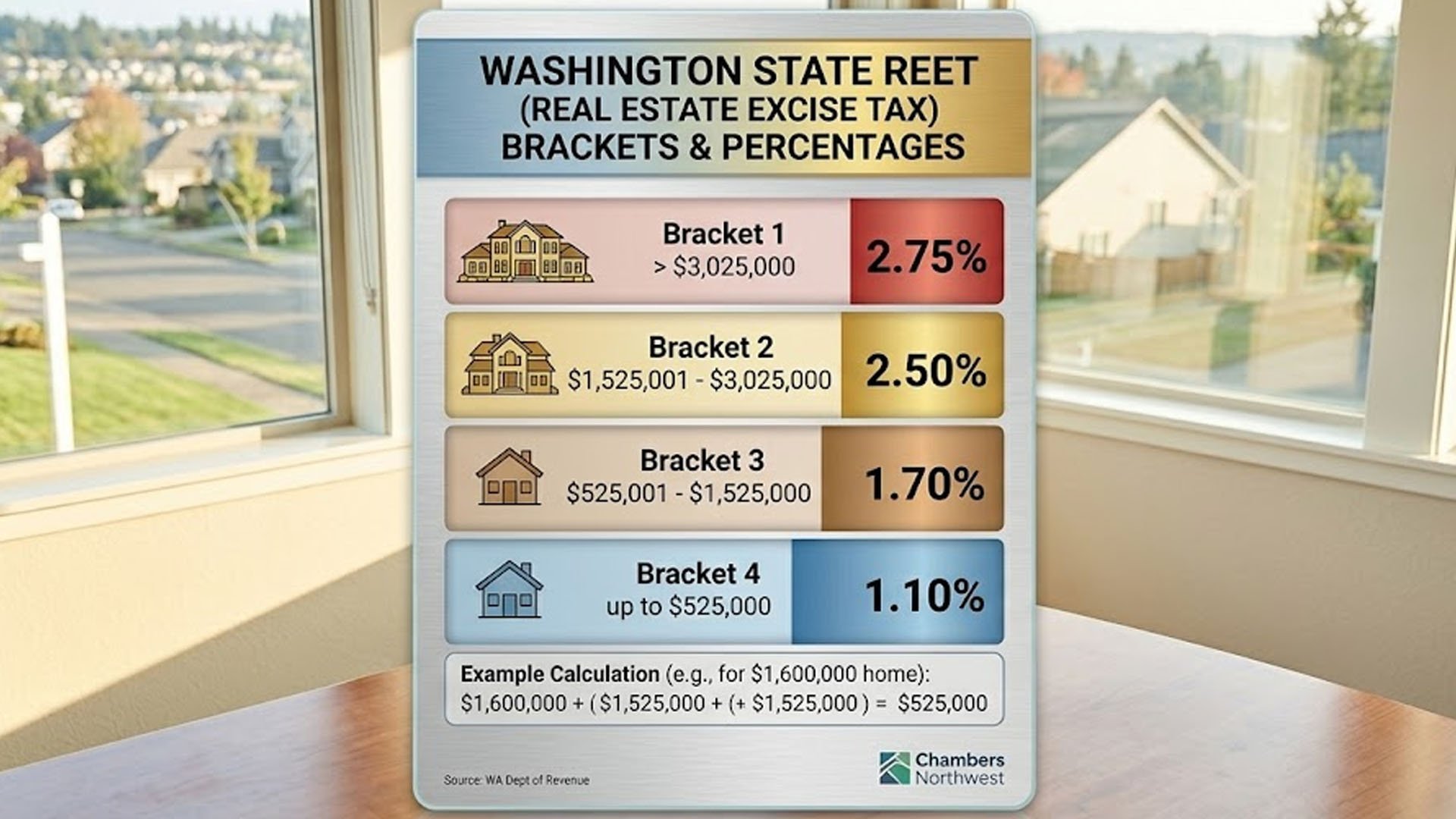
Washington uses a graduated real estate excise tax (REET). That means you don’t pay one flat rate; you pay tiers. Here’s the 2026 structure:
1.1% up to $525,000
1.28% from $525K to $1.525M
2.75% above $1.525M
3% above $3.025M
These are estimated figures based on 2026 REET rates and rounded for simplicity:
Sale Price | Total REET (Estimated) |
$800,000 | ~$13,300 |
$1,100,000 | ~$18,600 |
$1,600,000 | ~$35,400 |
And here’s a subtle one… That jump above $1.525M? It hits harder than people expect. Not a reason to price lower, but definitely something to understand when calculating your net. Want to see your exact number based on your price point? Run your numbers with a Seller Net Proceeds Estimator.
This is one area where I see a lot of confusion. Washington does have a 7% capital gains tax, but here’s the key detail most sellers don’t realize: it generally does NOT apply to real estate sales.
It primarily applies to financial assets like stocks and investments, not the sale of your primary home. On top of that, most homeowners also qualify for the federal capital gains exclusion:
Up to $250,000 (single)
Up to $500,000 (married)
So for many Eastside sellers, capital gains tax isn’t a factor at all. That said… there are exceptions. Rental properties, high-value gains, or unique financial situations can change the equation.
This is something I always recommend double-checking with a CPA before listing, especially if you’ve owned multiple properties or used the home as an investment.
If your home is in an HOA (and a lot are on the Eastside), this matters. When you sell, the HOA provides a resale certificate, basically a financial and operational snapshot for the buyer. You pay for it. Typical costs:
Resale certificate: $200–$600
Transfer fees: $100–$400
So realistically: $400–$800 total. And timing matters here. These documents can take up to 10 days, and buyers review them during inspection. Delay it, and you slow your deal.
These are the quieter costs. They don’t get talked about much, but they add up. Typical breakdown:
Escrow (your portion): $500–$700
Title insurance: ~0.25–0.4%
Recording + misc: $150–$300
Prorated property taxes: varies
On a $1.1M sale, you’re looking at roughly: $6,000–$9,000 total. Not massive individually… but together, they matter. At this point, most sellers are already surprised by how much gets layered in. Instead of estimating, you can plug in your exact scenario here: Run your numbers with a Seller Net Proceeds Estimator.
Let’s talk about staging. Because this isn’t about making your home “look pretty.” It’s about positioning. Eastside buyers are analytical. They compare. They notice details.
A staged home feels move-in ready. An unstaged one feels like a project. Typical costs:
Occupied home: $1,500–$5,000
Vacant home: $2,000–$8,000
And yeah… that’s not small. But here’s what I’ve seen again and again… Homes that show better don’t just sell faster. They sell closer to asking, or above it. And that gap? It’s usually bigger than the staging cost.
This is one of those things most sellers skip. And honestly… they shouldn’t.
For around $450–$700, you get a full inspection before listing. Why does that matter? Because buyers will do their own inspection. And when they find something you didn’t disclose…
They negotiate. Hard. Or walk away. But when you already know the issues? You control the narrative. You fix it. Or price it in. Either way… fewer surprises. Cleaner deals.
Time on market has a cost. Let’s break it down:
Mortgage interest (~$700K loan @ 6.5%): ~$125/day
Property tax: ~$28/day
Utilities + insurance: adds more
Hold your home for 30 extra days? That’s roughly $5,000–$6,000 gone. And that’s before any price reductions. So when someone says, “Let’s price high and test the market…” Just know, there’s a cost to that strategy.
If you’re in tech — Amazon, Microsoft, Google — this part matters. A lot.
They often cover $2,500–$5,000 in costs. Sounds helpful… but it won’t cover everything.
Big vesting year? That can push your income higher → higher taxes → different net. Sometimes, timing your sale around vesting actually changes your outcome meaningfully.
Relocation deadlines are tight. And that affects pricing strategy more than people expect.
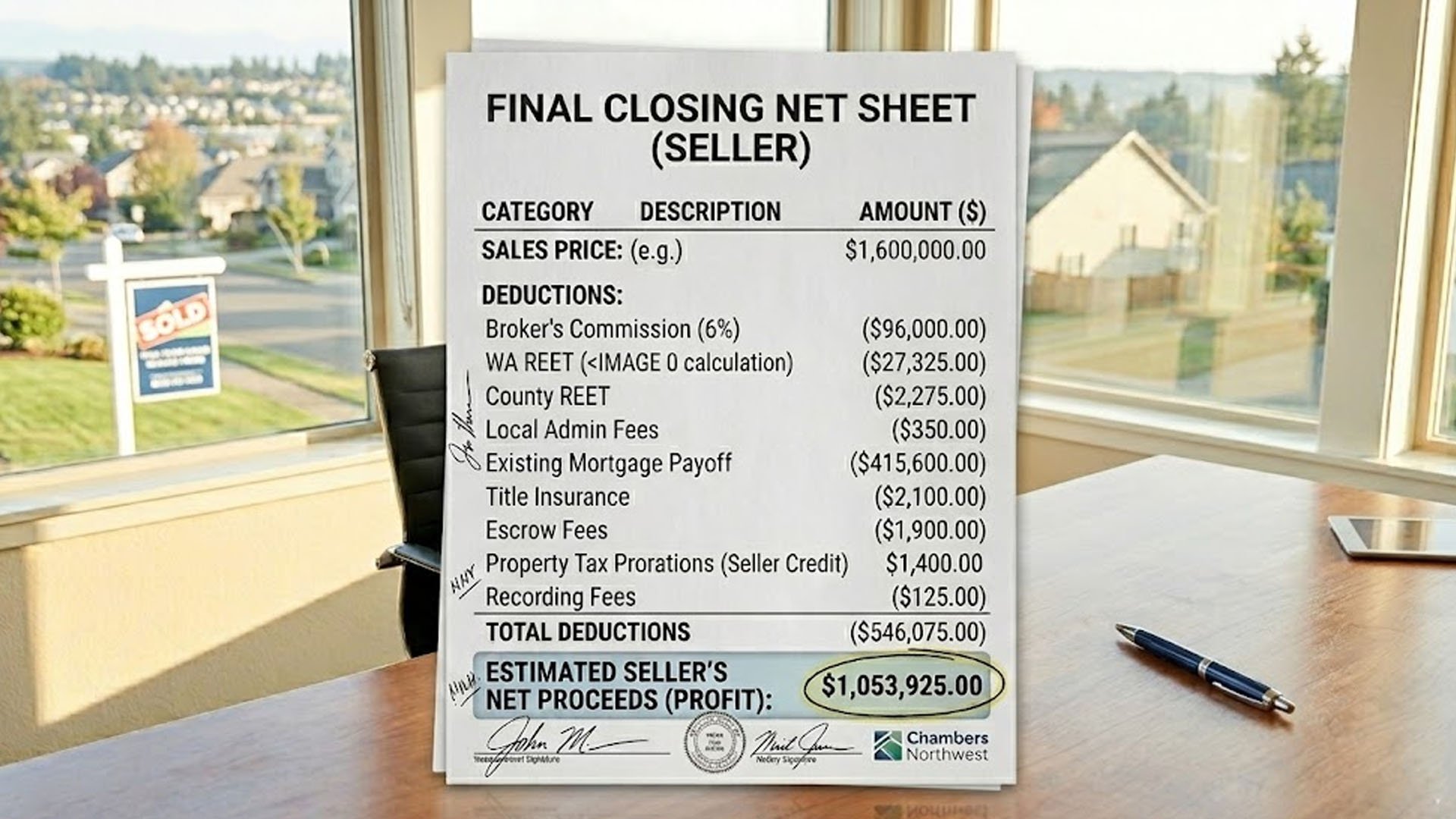
Let’s make it real. On a $1.1M sale:
Cost | Estimate |
Commission | $55,000 |
REET | ~$18,600 |
Closing costs | $7,500 |
HOA | $500 |
Staging | $4,000 |
Inspection | $550 |
Taxes/misc | $2,500 |
Total Costs | ~$88,650 |
So your net? ~$1,011,350 (before mortgage payoff & capital gains).
Selling a home on the Eastside isn’t complicated… but it is layered. And those layers? They’re where most people lose money.
Not because they made bad decisions. But they didn’t have the full picture early enough. Here’s what I’ve learned watching sellers go through this… The ones who net the most aren’t cutting corners. They’re making informed decisions before listing.
They understand the math. They plan around it. And they work with someone who treats their outcome like it actually matters. If you’re even thinking about selling, the smartest next step isn’t guessing your number. It’s seeing it clearly.
Most sellers don’t lose money because of one big mistake. It’s small assumptions that add up. The smartest first step? Run your numbers with a Seller Net Proceeds Estimator.
Then, if you want help interpreting it or building a strategy around it, we can walk through it together. You can get a personalized net sheet, real numbers, no pressure, directly through
Chambers Northwest. Get a consultation call today. Because once you know your real number… everything else gets easier.
Most sellers pay between 8% and 11% of the sale price, including commission, taxes, and closing costs.
Sellers pay REET (1.1%–3% + 0.5% local tax) and may pay capital gains tax (7%) depending on profit and exemptions.
Yes, in most cases. While not required after the 2024 NAR changes, most sellers still offer 2–2.5% to attract buyers.
Seller closing costs usually range between 0.5%–1% of the sale price, including escrow, title, and taxes.
Yes. Staged homes often sell faster and closer to the asking price, often covering the cost through higher offers.
Washington's 7% capital gains tax applies to financial assets, not real estate. Federal exclusions typically apply to primary residences. Consult a CPA if your situation involves rental use or significant appreciation.
The most accurate way is to use a personalized net sheet, which includes all fees, taxes, and your mortgage payoff.
Stay up to date on the latest real estate trends.
buying
selling and buying
Selling

buying
selling and buying

Selling

selling and buying
Selling
selling and buying
Contact Details

Nic Chambers
11901 NE Village Plaza, Suite 271 Kirkland WA 98034