Should You Sell First or Buy First in King County? A 2026 Eastside Guide
selling and buying Nic Chambers August 10, 2026
selling and buying Nic Chambers August 10, 2026
Every move-up seller I work with eventually asks some version of the same question: do I sell first, or do I buy first? There's no universal answer, and anyone who gives you one without asking about your equity, your city, and your risk tolerance is skipping the parts that actually matter.
Here's the real trade-off behind each path, the financing tools that bridge the gap, and why the right answer for a Bellevue seller can look different than the right answer for a Kirkland seller right now.
None of this replaces a conversation about your specific numbers, but it's the same framework I walk clients through before we build a moving plan.
Selling first gives you a clear number. You know your exact equity, you're not carrying two mortgages, and you can make a stronger, non-contingent offer on your next home because your financing isn't dependent on a sale that hasn't happened yet.
In a competitive Eastside market, that non-contingent status matters more than people expect. Listing agents representing the home you want to buy will tell you plainly that a sale-contingent offer loses to a clean one almost every time there's real competition, and in 2026's environment, most sellers who receive multiple offers have at least one clean offer to choose from. The trade-off is a housing gap: you may need temporary housing, or you're negotiating a rent-back from your buyer while you search for your next place under time pressure.
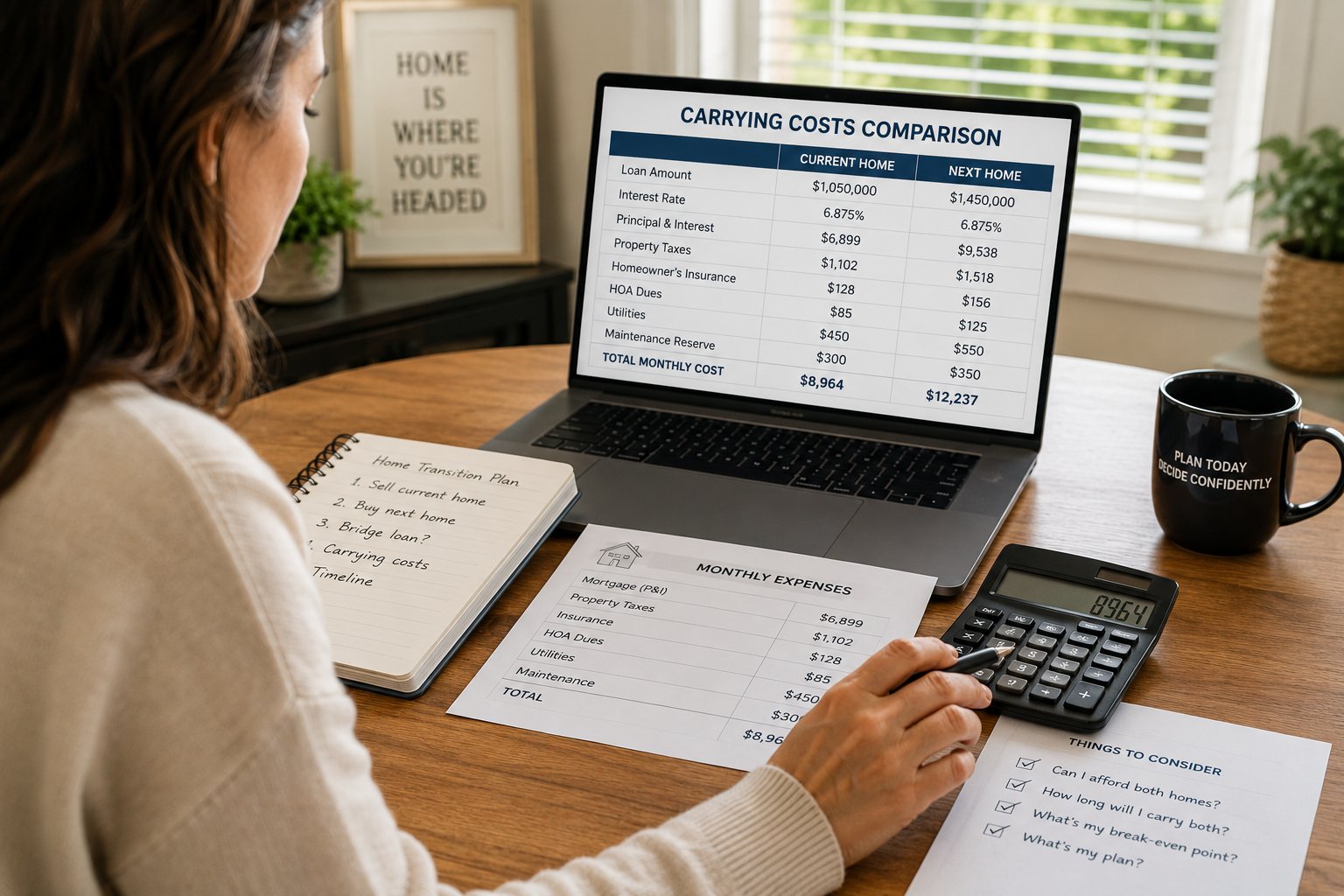
Buying first removes the pressure of finding temporary housing, but shifts the financial risk to carrying two homes at once. You move once, you're not scrambling to find temporary housing, and you can take your time finding the right next home instead of settling under a deadline. The cost is real: you're carrying two mortgages, or a bridge loan, until your current home sells, and if your home takes longer to sell than expected, that carrying cost adds up fast. It's worth running that carrying-cost math honestly before committing to this path, since a few extra months of two housing payments can offset a meaningful share of whatever gain you were hoping to capture by moving without a deadline.
This is where citywide market conditions actually change the math, not just the emotional comfort level. Bellevue is still running tight, with roughly 2.4 to 2.6 months of supply and homes selling in about 8 days. In a market that tight, selling first carries relatively low risk: you're unlikely to be caught without a buyer for long, so the housing-gap risk of selling first is smaller than it would be in a slower market.
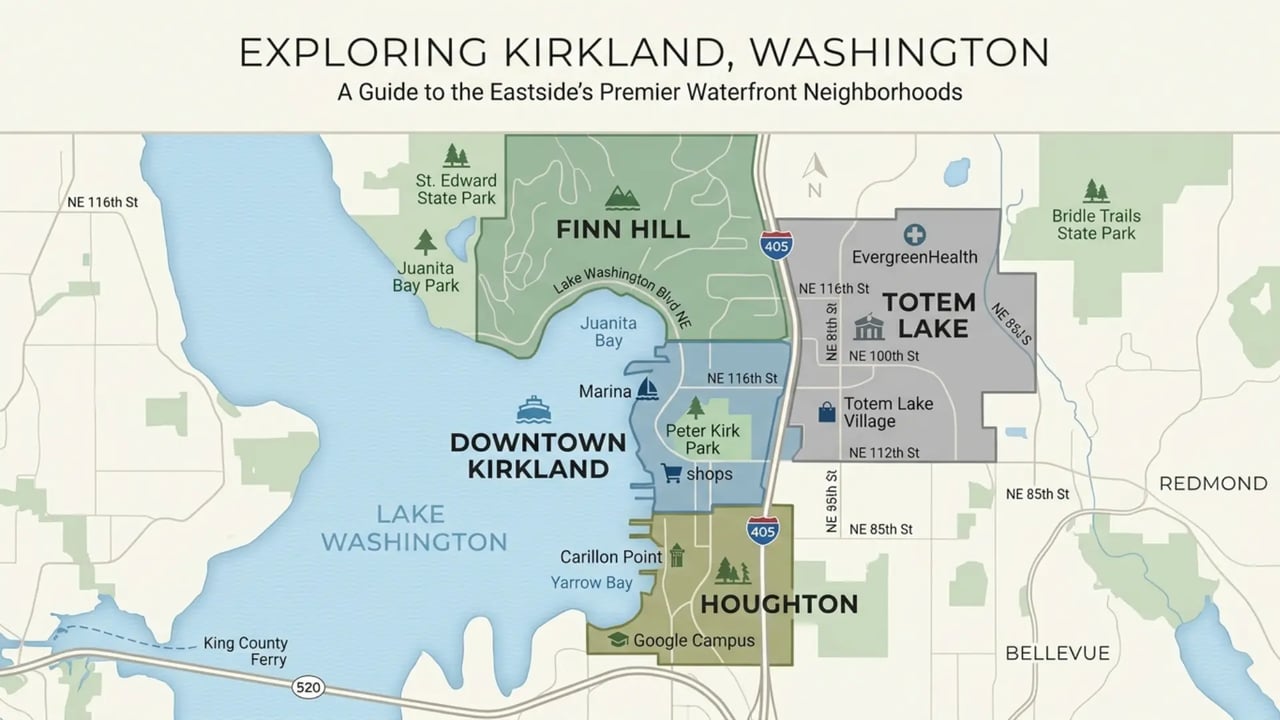
Kirkland tells a different story. Supply there has climbed to roughly 4.2 to 4.3 months, with inventory up about 34 percent year-over-year and days on market stretching to around 13. A Kirkland seller waiting to sell first before making an offer risks losing the home they want to another buyer who isn't waiting on a sale. In that market, buying first, if you can carry the financing, or negotiating a longer close on your purchase to give your sale time to catch up, becomes a more reasonable strategy than it would be in Bellevue's tighter conditions.
Before choosing a financing tool, it helps to see the carrying cost in real numbers rather than the abstract.
On a $1.3 million Kirkland home with a $500,000 remaining mortgage balance, you're looking at roughly $3,160 a month in principal and interest at current rates, plus property taxes running about 0.84 percent annually, or around $910 a month, plus insurance and basic upkeep. Add a bridge loan or HELOC payment on top of your existing mortgage on the home you're leaving, and two to three months of overlap can easily run $10,000 to $15,000 in carrying costs before your original home even closes. That's not a reason to avoid buying first. It's the number that should drive whether you do.
A bridge loan is short-term financing, typically 6 to 12 months, secured against the equity in your current home, used to fund the down payment on your next one before your current home sells. Most lenders want at least 20 percent equity in the home you're selling, and some will go as low as 15 percent, with qualification based on your ability to carry both mortgages plus the bridge payment within standard debt-to-income limits, generally 43 percent or lower. Current bridge loan rates run roughly 9 to 11 percent, interest-only, reflecting the short-term, higher-risk nature of the product.
A HELOC drawn against your current home's equity, set up before you list, is often a cheaper way to fund a down payment than a dedicated bridge loan, though the rate is variable and tied to the prime rate, which remains well above where it sat in 2021 and 2022. Either tool gets you to the same place: a non-contingent offer on your next home, backed by equity you haven't technically converted to cash yet.
Worth knowing if you're financing the purchase side: King County's 2026 conforming loan limit is $1,063,750. Most homes in Bellevue's core neighborhoods, and a growing share in Kirkland, price above that threshold, which means your next purchase is likely jumbo financing, with stricter credit and reserve requirements than a conforming loan.
That's worth confirming with your lender before you assume a bridge loan or HELOC amount will cover the gap you're expecting.
A rent-back agreement lets you sell your current home, then stay in it as a renter for an agreed period, typically 30 to 60 days, while you search for and close on your next home. It's a genuine middle path: you get the certainty of selling first, a firm equity number, and a non-contingent offer on your next home, without needing temporary housing or storage in between.
The trade-off is timeline pressure. You're on the clock to find your next home within the rent-back window, and if that search takes longer than expected, you're back to weighing temporary housing against asking your buyer for an extension, which they aren't obligated to grant.
Coordinating both transactions through a single agent is one of the more underrated advantages in a sell-first-or-buy-first situation. The timing, the contingency language, the financing handoffs, and the moving logistics all need to work together, and splitting the two sides across separate agents adds friction at exactly the moments where smooth coordination matters most.
There's no single right answer to sell-first-or-buy-first, but there is a right answer for your equity position, your target neighborhood, and your risk tolerance.
Sell first if:
Buy first if:
A Bellevue seller sitting on substantial equity in a tight, fast-moving market can reasonably sell first with minimal gap risk. A Kirkland seller eyeing a competitive listing in a market where inventory is growing may need a bridge loan, a HELOC, or a longer close to buy with confidence before their current home sells.
Running the actual numbers on your specific equity and timeline, rather than defaulting to whatever worked for a friend or neighbor, is what separates a smooth move from a stressful one. I've coordinated both sides of this transaction enough times to know the plan that looks best on paper isn't always the one that holds up once real offers and real deadlines enter the picture, which is exactly why it's worth running your specific numbers before you commit to a path.
Want to work through your specific sell-first-or-buy-first math? Talk to Nic About Your Move for a combined seller and buyer consultation. You can also start with the Seller Net Proceeds Calculator to see your equity position, or explore what's available on the buy side while you plan your timeline.
Can I buy a house before selling mine?
Yes, if you have enough equity and can qualify for bridge financing or a HELOC. The trade-off is carrying two housing payments until your current home sells, typically $10,000–$15,000 over two to three months of overlap.
Do I need a bridge loan?
Not always. A HELOC drawn against your current equity before you list is often cheaper. A bridge loan makes sense when you need more capital than a HELOC provides. Either way, you'll need at least 20% equity and a debt-to-income ratio under 43% to qualify.
What is a rent-back agreement?
You sell your home, then stay in it as a short-term renter after closing while you find your next place. In Washington, rent-backs are capped at three months under NWMLS Form 65B. Rent, move-out date, and deposit terms are all set in writing at the time of sale.
Is it better to sell first in a buyer's market?
Yes. When inventory is rising and homes are sitting longer, the risk of buying first increases, your current home may take longer to sell than expected, and carrying two payments in a softening market is expensive. Selling first removes that uncertainty.
Can I make an offer contingent on selling my home?
You can, but it's a competitive disadvantage on the Eastside. A clean offer beats a contingent one almost every time there's more than one buyer. Contingent offers work better on homes that have been sitting or in slower price segments where sellers have less leverage.
How long can a seller stay after closing in Washington?
Up to three months, under NWMLS Form 65B. Most Eastside rent-backs run 30 to 60 days. If the seller doesn't vacate by the agreed date, the buyer may need to pursue unlawful detainer proceedings, so the move-out date needs to be realistic before you agree to it.
Stay up to date on the latest real estate trends.
buying
selling and buying

Selling

buying
selling and buying

Selling
selling and buying
Selling

selling and buying
Contact Details

Nic Chambers
11901 NE Village Plaza, Suite 271 Kirkland WA 98034