Are Realtor Fees Negotiable in King County? What Eastside Sellers Should Know
Nic Chambers June 22, 2026
Nic Chambers June 22, 2026
People of Kirkland and Bellevue get it wrong: they go into agent interviews laser-focused on the commission percentage. That's understandable. It feels like the one number you can control. After more than 200 transactions, I've found that sellers often focus on the commission percentage before evaluating the factors that have the biggest impact on their net proceeds. In many cases, pricing strategy, preparation, negotiation, and marketing execution matter far more than a half-point difference in commission.
But on a $1.2M Eastside home, obsessing over whether you pay 2.5% or 3% in listing fees, a $6,000 difference, while ignoring Washington's graduated excise tax, escrow costs, and buyer concession decisions, can mean leaving far more on the table than you saved.
Yes, realtor fees are negotiable in King County. Always have been. The 2024 NAR settlement made the rules around that even clearer. But negotiating well means knowing what to push on, what actually moves your net number, and what trade-offs you're making when you chase the lowest percentage. That's what this guide is really about.
Before you can negotiate anything intelligently, you need to see the whole board. Most sellers know about commission. Not everyone thinks through the rest.
This is your agent's fee for marketing and selling your home. In Kirkland, Bellevue, and the broader Eastside, typical listing agent rates run between 2.5% and 3%. On a $1.2M home, that's $30,000 to $36,000. It's negotiable. We'll get into how in a minute.
Since August 2024, you're no longer required to offer buyer's agent compensation through the MLS. That's a real change. But here's what's actually happening in the Eastside market right now: most sellers are still offering it.
Most Eastside sellers are still covering the buyer's agent commission. Redfin reports that the majority of sellers nationwide are still choosing to pay it, even though the MLS requirement is gone. Why? Not offering it can shrink your buyer pool in a market where agents not offering compensation can reduce flexibility in negotiations and may affect how some buyers approach the transaction.
Most Eastside sellers are landing at 2% to 2.5% as a buyer concession. That's your call to make, but make it with eyes open, not by default.
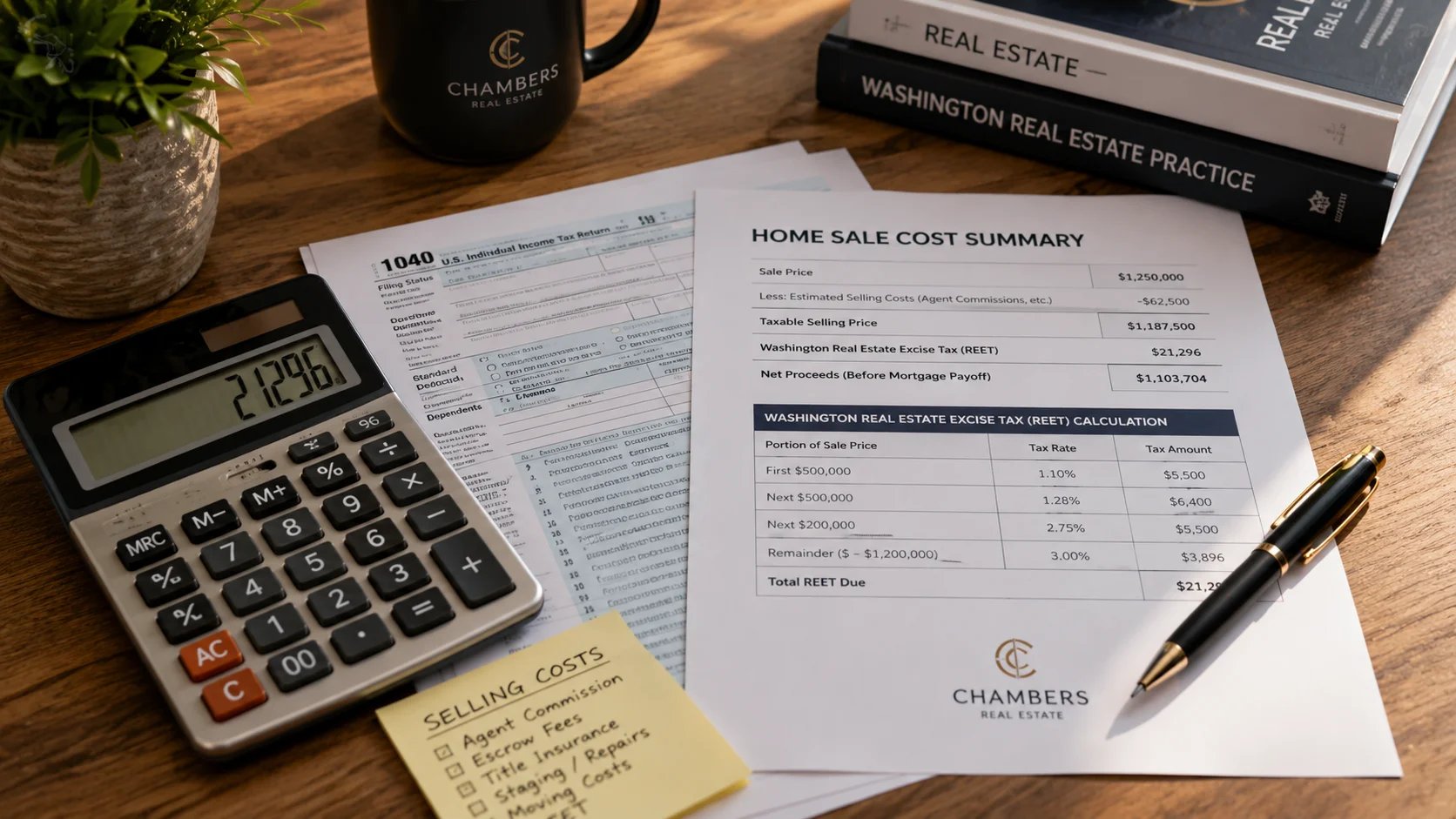
Washington's Real Estate Excise Tax (REET) is where a lot of Eastside sellers get surprised. It's not a flat rate; it's graduated based on your sale price. As of 2026:
State: 1.1% x $525,000 = $5,775
State: 1.28% x $675,000 = $8,640
State subtotal = $14,415
King County local: 0.50% x $1,200,000 = $6,000
Total REET = $20,415
On a $1.2M Kirkland sale, that works out to roughly $20,400 in REET, about $14,400 in state REET plus $6,000 in King County's 0.50% local REET. Many sellers miss the local portion entirely. You can't negotiate this one; it's state law. But you need to plan for it, because sellers often forget it when running mental math on their net.
On a typical Eastside sale, escrow and title fees run $2,500–$4,500, depending on the sale price and company. Add recording fees, any HOA transfer fees, and pre-closing repairs, and your total non-commission closing costs can easily hit $15,000 or more. None of this means the commission conversation isn't worth having. It absolutely is. It just means you need the full picture first.
Most full-service listing agents on the Eastside are sitting at 2.5% to 3%. Washington's average total commission is about 5.90% as of early 2026, slightly above the national average of 5.70%, and meaningful money on high Eastside prices. Some discount brokers advertise 1% to 1.5% listing fees in Bellevue and Kirkland. Those numbers are real, but so are the trade-offs.
The settlement didn't just change who pays what; it changed the transparency around the whole process. Two things that matter for Eastside sellers right now:
• Buyer agent compensation can no longer be advertised on the MLS. It's now a separate, deal-by-deal negotiation, giving you more control over what you offer.
• Buyers must sign written agreements with their agents before touring homes, so fees on the buyer's side are more visible and more negotiable than before.
What hasn't changed: commission rates aren't set by law and never were. Every percentage you see is a starting point, not a rule.
This is the part nobody wants to say out loud. An experienced Eastside agent who consistently gets 3–5% over asking in your neighborhood is worth more to you at 3% than a discount broker who struggles to hold price at 1.5%. In neighborhoods like West Bellevue, Bridle Trails, Houghton, and Somerset, I've seen well-prepared homes generate multiple offers that more than offset commission differences sellers initially focused on. The bigger question is usually not what the agent charges—it's whether they can create enough demand to improve your final outcome.
On a $1.2M home, landing $30,000 over asking covers your entire listing commission. Dropping $30,000 below asking to close faster costs you that same amount, twice over. The negotiation that matters isn't always the rate. It's whether the agent you're hiring can maximize what that rate is applied to.
Before you ask what they charge, ask what they deliver. These questions separate good agents from expensive ones:
• What's your average sale-to-list ratio on Eastside homes in the last 12 months?
• How many of your listings have had price reductions?
• What does your marketing plan look like for a home at this price point, specifically?
• How do you handle multiple offer situations? Walk me through a recent example.
An agent who answers these with specifics, not generalities, has earned their rate. One who pivots to talking about 'experience' and 'dedication' without data? That's a signal. Ask for examples. A strong agent should be able to show you recent Eastside listings, explain how they priced them, what challenges arose, and how they navigated negotiations. General promises are easy. Specific examples are harder to fake.
If you want to negotiate from 3% down to 2.5%, give the agent something in return. Options that tend to work on the Eastside:
• Exclusivity with a faster timeline, offering to list within two weeks if they reduce the rate
• A home that's already in great condition, less prep work means less agent lift
• A realistic price, agents will often negotiate more on homes priced to move
• A back-end referral if you're also buying, some agents will reduce the listing fee in exchange for representing you on your next purchase
What not to trade: your marketing budget. Cutting professional photography, video walkthroughs, or paid digital promotion to save on the rate is one of the most reliable ways to make your home sit longer and sell for less.
There are legitimate low-commission brokers operating in Kirkland and Bellevue, 1% to 1.5% listing fee structures are real. For the right seller and the right home, they can make sense.
But the Eastside market is competitive and high-stakes. Most discount models work on volume, which means less hands-on attention per listing. That's not a knock; it's a trade-off you need to understand before signing. If you go that route, ask specifically: Who is my point of contact? How many listings do they currently carry? What's included in the flat fee vs. what costs extra?
Here's what two realistic scenarios look like on a $1.2M Kirkland sale:
• Listing commission: $36,000
• Buyer concession: $30,000
• REET (approx.): $20,415
• Escrow/title (approx.):~$1,110,085
Estimated seller net: ~$1,120,700
• Listing commission: $30,000
• Buyer concession: $24,000
• REET (approx.):$20,415
• Escrow/title (approx.): $3,500
Estimated seller net: ~$1,122,085
The difference between these two scenarios is about $12,000, real money. For many sellers, $12,000 can represent a large portion of a moving budget, renovation fund for the next home, or months of mortgage payments. That's why it's important to evaluate every fee decision in the context of your total net proceeds—not in isolation. But if Scenario A's agent gets you $20,000 more on the sale price because of better negotiation or marketing, Scenario B's savings disappear completely.
That's why net proceeds matter more than the rate. The rate is one input. What you actually walk away with is what counts.
See What You'd Net After Fees: Use the Chambers NW Net Proceeds Calculator, plug in your home value and fee structure to see your real net in seconds. No obligation.
Realtor fees in King County are negotiable. The 2024 NAR settlement reinforced that, and the Eastside's higher price points give sellers real leverage to push on rates.
But the sellers who come out ahead aren't necessarily the ones who found the lowest percentage. They're the ones who understood all the costs, asked the right questions, hired an agent who delivered on their sale price, and made intentional decisions about buyer concessions instead of defaulting to whatever felt standard.
A half-point difference in commission is a number. What you actually walk away with is a result. Focus on the result.
If you're thinking about selling in Kirkland, Bellevue, Redmond, Issaquah, or anywhere on the Eastside, and want to see what your real net looks like, including commission, REET, and closing costs. Before negotiating commission, it's worth understanding the full picture—your likely sale price, REET, closing costs, buyer concessions, and net proceeds. I regularly help Eastside sellers compare different pricing and commission scenarios so they can make informed decisions based on real numbers, not assumptions.
Run your Seller Net Proceeds Estimate or schedule a consultation with Nic Chambers to review your specific situation.
Stay up to date on the latest real estate trends.
buying
selling and buying
Selling

buying
selling and buying
Selling
selling and buying
Selling
selling and buying
Contact Details

Nic Chambers
11901 NE Village Plaza, Suite 271 Kirkland WA 98034